
Author: Davidson LifeLine

  • Empower Yourself 👊

    Empower Yourself 👊

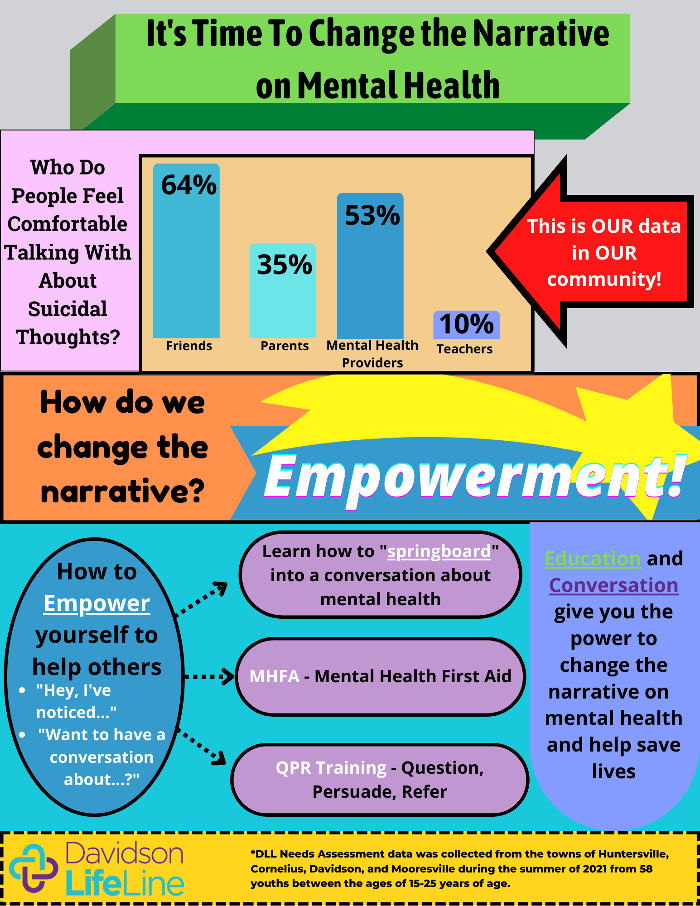
    While people may recognize where support for mental health issues can be found, it is often more difficult to ask for help. Our study focused on youth in the LKN area between the ages of 15-24 years old. It found that while respondents could identify multiple sources of support in their lives, they often felt significantly less comfortable discussing their mental health struggles with those same sources (Benziger & Wipper, 2021). The majority of respondents felt that if they were experiencing suicidal thoughts they could discuss them with friends or a mental health provider. We found that fewer respondents felt comfortable talking with family, and even fewer would talk to school staff about these thoughts.

    The table below shows a detailed breakdown of whom respondents would tell if they were experiencing suicidal thoughts. The results show that adolescents feel more comfortable talking to their friends first. While developmentally appropriate, that lack of openness reflects the stigma around mental health, and we need to change that narrative. Instead of relying on those experiencing mental health issues to come forward and ask for help, we can learn to be comfortable opening up the conversation and taking the initiative.

    Knowing how to start a conversation about mental health and suicidal thoughts is a major way we can break down stigma. People naturally feel uncomfortable talking about something they do not know much about. This is why it’s important to empower ourselves to break down those walls and normalize the conversation about mental health. Some conversation starters are things like “I’ve noticed you haven’t seemed yourself lately…”, or “I’m wondering if you want to get together and have a conversation…”. This shows curiosity and begins to build a connection with the person who is struggling. It is also important to frequently make eye contact with that person, as it has been shown to be one of the most powerful ways to create a link between two people (Farroni et al., 2002). This can help ease the conversation about this difficult topic.

    You can empower yourself through resources such as MHFA (Mental Health First Aid), QPR training (Question, Persuade, Refer), or by reading articles related to mental health. Together we can change the narrative by using our resources and empowering ourselves to be comfortable talking about mental health.
    Sign up for Mental Health First Aid

    September 12 AND 13, 6:00-8:30 both nights – virtual

    Sign up for QPR

    – 8/23 and 9/22 – 6-8:30p – free

    Sign up at www.townofdavidson.org/dpr. These programs are no cost to you.

    References:

    Benziger, A., Wipper, L. (2021). Davidson LifeLine Needs Assessment: Youth Mental Health [PowerPoint Slides]. https://docs.google.com/presentation/d/13re-qdnZi9cY861S9iN_7v4mbyfxt4uE/edit#slide=id.p1

    Farroni, T., Csibra, G., Simion, F., & Johnson, M. H. (2002). Eye contact detection in humans from birth. Proceedings of the National Academy of Sciences99(14), 9602–9605. https://doi.org/10.1073/pnas.152159999

    Lovato, N., & Gradisar, M. (2014). A meta-analysis and model of the relationship between sleep and depression in adolescents: Recommendations for future research and clinical practice. Sleep Medicine Reviews, 18(6), 521–529. doi:10.1016/j.smrv.2014.03.006

    Meldrum, R. C., & Restivo, E. (2014). The behavioral and health consequences of sleep deprivation among U.S. high school students: Relative deprivation matters. Preventive Medicine63, 24–28. https://doi.org/10.1016/j.ypmed.2014.03.006

  • Stigma Stomping

    Stigma Stomping

    Davidson Lifeline has always been so fortunate to have incredible partnerships. Last summer two fabulous and ambitious students from the UNCC Master of Public Health program, Alyssa Benziger and Landis Wipper, created a Needs Assessment for our Lake Norman community, designed to measure mental health concerns and care availability for young people aged 15-24 in our region. The results were a fascinating and sobering snapshot of how we are meeting, and not meeting, their needs. This summer, we again are lucky to have Jeff Maenner, also a UNCC Master of Public Health student, who is creating blog posts, social media posts and videos to help us disseminate the information.  


    Mental health issues are more common in the United States than you may think. In fact, 1 in 5 of us will experience a mental disorder in any given year and half of us will be diagnosed with some type of mental disorder during our lives (SAMHSA, 2016). Unfortunately, fewer than half of U.S. adults get treatment for their mental illness. Barriers to receiving treatment include transportation, insurance and financial cost, or lack of specialized services. Stigma has been identified as one of the most common barriers, especially in a town like Davidson where most people have access to care. The stigma may be even worse when they are experiencing suicidal thoughts, since suicide is considered an uncomfortable and even taboo topic to discuss.

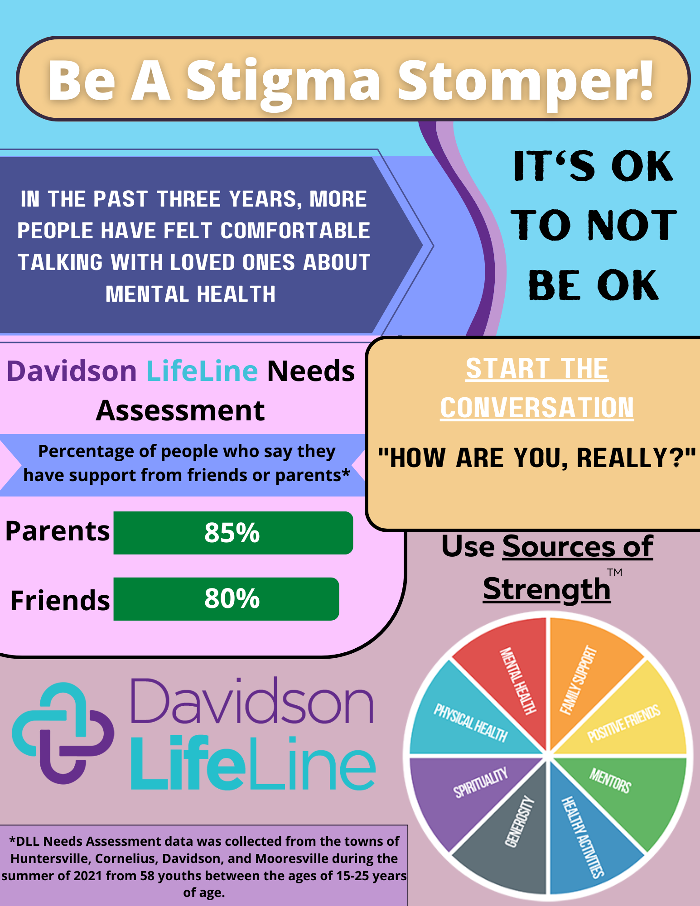
    Our Needs Assessment conducted in the summer of 2021 found that 70% of respondents did not believe that they would get support from their community (Benziger & Wipper). This perceived lack of support makes it difficult for these individuals to seek help if they believe they may be excluded from the community. The good news is that they listed family and friends as valuable sources of support. The Needs Assessment did find that 85% of respondents trusted their friends to support them and that 80% trusted their family to support them if they were diagnosed with a mental illness.

    While perceived stigma still exists in the community of Davidson, more people are engaging in the conversation about mental health. Recent years have seen an increase in youth discussing mental health in the community. It may be difficult dealing with mental health issues even after opening up the conversation, so it is important to utilize all the resources at your disposal. One such resource, the Sources of Strength Wheel, lists eight categories of protective factors to assist and enhance your wellbeing. These can help you identify methods of support and prevent further mental health issues. By being more open about mental health and having conversations in our community, we can stomp the stigma of mental health.

    It is important that we are open about the conversation regarding mental health and do not shy away from it. People who are dealing with mental health issues may feel isolated if they think their issues are being ignored. This isolation and lack of support can actually worsen the mental health of these individuals (Leigh-Hunt et al., 2017). While support can come from loved ones and people who are close with the individuals experiencing mental health issues, it can also come from the community. A study performed by Townley et al. found that interactions with people in stores and shops around the community were determined to be an additional source of support (2013).

    This is good news for Davidson, as 50% of respondents in our Needs Assessment listed Davidson as being a compassionate community for people experiencing mental health issues; this was one of the highest results in our Needs Assessment (Benziger & Wipper, 2021). People with mental health issues have listed family, friends, and the community as close sources as support (Salehi et al., 2018). By supporting the people who need us, we can increase their mental health recovery and destigmatize conceptions about mental health.

    Recovery for mental health is possible, so let’s come together as a community to end the stigma and follow the guidance of the phrase “it takes a village”.

    We’d love for you to share this social media post!

  • Growing Together

    Growing Together

    by: Maleah Thompson, senior, William A. Hough High School

    I came home in June of 2015 to my mom asking me to sit on the couch and talk. I made my way to the couch to see her in a somber stance. I asked “what’s wrong” and the words that came out of her mouth forever changed my view on the importance of life.

    I had seen my friend when she helped our family move into a new house no less than ten days prior, and suddenly received the news that she transitioned into her next stage of life. I was eleven years old and wondered how I hadn’t noticed anything at the recent Thanksgiving dinner. I was in a state of shock and did not know what to do. I thought, “there must have been something I could have done”, whilst holding an immense sense of guilt. At her funeral, we stood with her family. When I heard the first line, “Come up to meet you, tell you I’m sorry” of Coldplay’s The Scientist, I could not take it anymore. I ran to the bathroom, heaving, with tears running down my face. I had not been close to her in years yet I still felt such pain and could not comprehend that she was gone.

    It took me years to figure out that it indeed was grief, and although I was not in her inner circle, that grief was valid.

    I have recently heard classmates criticize others for having feelings involving grief about suicides in our community, yet could not understand why there was so much strife on the topic. Although someone is not a person’s best friend, mother, or teacher, it does not take away from the loss the community has faced. Everyone grieves in their own way and no one has jurisdiction over a person’s life and what it can mean to others.  I find no sense of progress in putting down others in our community for grieving over a tragedy, whether they knew the person on an intimate level or not. I have been in differing situations in levels of “closeness” to a person who passed due to suicide, and proximity does not take away from the validity or poignancy of anyone’s feelings.

    Any form or amount of grief is valid. Rather than going it alone, let us acknowledge others and attempt to grow together, instead of tearing each other down.

    Maleah

  • What will you know at the end of this month that you didn’t know before?

    What will you know at the end of this month that you didn’t know before?

    By Jaletta Albright Desmond, Davidson LifeLine president

    Even though it has been around since 1949, I used to be clueless about May being Mental Health Month. To be honest, I wish I still was.

    Basically, every month now is Mental Health Month in my life and in my volunteer work. I am grateful there’s a month where everyone is encouraged to pay attention to their brain health.

    It’s not as though I wasn’t aware of mental and behavioral health before my oldest daughter died by suicide in 2012, along with four other Davidson residents. I was paying careful attention to her mental health, her diagnosed low grade depression. But I could’ve educated myself more. I could’ve tried to better understand depression, the teen brain and impulsivity. I had even researched and written a column about suicide a year or two before my daughter took her own life—but I didn’t know then that she was suicidal and I didn’t really know what signs or symptoms to look for. And I didn’t know I needed to know.

    It’s tough sometimes to separate typical adolescent behavior from mental illness. It’s tough sometimes to separate typical adult struggles from mental illness.

    May is the month to learn more. Below  you will find links just a few links where you can explore with experts and national organizations to learn more about mental health and behavioral issues, brain health and suicidal ideation. You can learn about stigma and the damage it does to society when we judge, criticize or avoid mental health. You can learn about resilience and how to grow from the struggles we all face. You can also join Davidson LifeLine online for the evidence-based suicide prevention training QPR (Question-Persuade-Refer). QPR teaches you how to recognize signs and ask a person if they are thinking about suicide, persuade them to get help, and refer them to the appropriate professionals or resources. Particularly right now, life is upended and calls into suicide helplines have climbed so rapidly that some of those individuals working helplines, answering phone calls from people in crisis, are now overwhelmed, facing their own emotional struggles. Let’s do what we can to help those around us, to help ourselves. Let’s take this month to learn more.

    I’d be glad for Mental Health Month to become obsolete because we are paying attention to it every month, every day.

    https://www.davidsonlifeline.org/event/virtual-qpr-question-persuade-refer-2/

    https://mhanational.org/mental-health-month

    https://thekennedyforumillinois.org/mentalhealthmonth2020/

    https://nami.org/Get-Involved/Awareness-Events/Mental-Health-Month

    https://www.samhsa.gov/faith-based-initiatives